
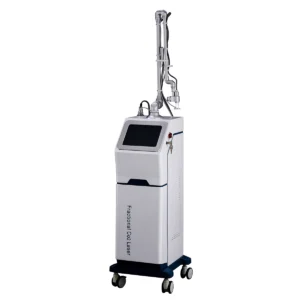
A fractional CO2 laser machine can become an important treatment platform for an aesthetic clinic. But choosing the right system is not as simple as comparing 30W with 40W, counting handpieces, or selecting the lowest quotation.
Machines that look similar may differ in their laser source, pulse control, scanner, optical delivery system, safety design, documentation, and after-sales support.
The best machine is not automatically the most powerful or most expensive one. It is the system that matches your clinic’s treatment plan, workload, operator qualifications, local requirements, and long-term budget.
Quick Answer: What Should You Check?
Before buying a fractional CO2 laser machine, check six areas:
- The treatments your clinic plans to offer
- The laser source and its replacement policy
- Power, pulse modes, and output control
- The fractional scanner and articulated arm
- The treatment functions and accessories you really need
- Documents, training, spare parts, and technical support
Do not judge a machine by wattage, screen size, or appearance alone.
1. Start with Your Clinic’s Treatment Plan
You can first review our treatment solutions based on your clinic’s planned services.
A fractional CO2 laser may be configured for fractional skin resurfacing, scar-related treatments, surgical cutting, or optional intimate-care applications.
These functions may require different handpieces, scanners, software, and operator qualifications.
Ask yourself:
- Which treatments will be offered first?
- How many treatments do we expect each week?
- Do we need only fractional resurfacing or additional functions?
- How much space is available in the treatment room?
- What documentation is required in our market?
- May we expand the treatment menu later?
A clinic focused mainly on skin resurfacing may not need every optional module. A medical center planning several CO2 procedures may need a more flexible platform.
Choose the configuration your business can use safely and profitably—not the longest function list in the catalogue.
2. Understand the CO2 Laser Source
The laser source is one of the most important parts of a fractional CO2 laser machine.
Suppliers may offer a glass tube, an RF-excited sealed metal tube, or different source options for different configurations.
These source types can differ in:
- Initial cost
- Pulse characteristics
- Cooling requirements
- Maintenance
- Expected service life
- Replacement cost
However, the words “RF metal tube” or “glass tube” do not prove the quality of a complete machine.
Ask the supplier:
- What source type is used in the exact machine being quoted?
- Who is the manufacturer, and what is the model?
- What pulse modes does the source support?
- How is output stability tested before shipment?
- How long is the source warranty?
- What is the replacement cost?
- Can a replacement source be supplied later?
- Will replacement require optical realignment?
The right choice depends on your workload, budget, performance requirements, and access to technical service.
Do not ask only:
Which tube is better?
Ask instead:
Which source gives our clinic suitable control, stability, maintenance, and long-term operating cost?
3. Check Power and Pulse Control
Maximum wattage is easy to compare, but it does not describe the whole system.
A 40W machine is not automatically better than a 30W machine.For clinics that prefer a compact system, a 30W desktop fractional CO2 laser machine may also be worth comparing.
Practical performance also depends on:
- Pulse duration
- Pulse frequency
- Dwell time
- Spot size
- Scanning density
- Beam quality
- Output repeatability
When comparing a fractional CO2 laser machine, ask:
- Is the stated wattage the rated source power?
- Which pulse modes are available?
- Which parameters can the operator adjust?
- How small are the adjustment steps?
- Does the output remain stable during repeated operation?
- Can the supplier demonstrate different settings in real time?
A high maximum power may look impressive on a specification sheet. But stable and controllable output is more important in daily professional use.
The detailed choice between 30W and 40W should be based on the complete configuration and expected workload, not the power number alone.
4. Evaluate the Fractional Scanner and Articulated Arm
The fractional scanner controls how laser spots are distributed over the treatment area.
Check whether the system allows useful adjustment of:
- Pattern shape and size
- Dot spacing
- Treatment density
- Dwell time
- Scanning sequence
- Repetition mode
More patterns do not automatically mean better performance.
The important question is whether the scanner produces a consistent pattern and responds accurately when the operator changes the settings.
Ask for a live demonstration of:
- Small and large scanning areas
- Different treatment densities
- Different pattern shapes
- Repeated scanning
- Parameter changes in real time
The articulated arm also affects daily operation. It should move smoothly, remain in position, and allow the operator to control the handpiece comfortably.
Check:
- Is the arm balanced?
- Do the joints move smoothly?
- Does the handpiece feel stable?
- How is the arm protected during shipping?
- Does the supplier provide alignment support after delivery?
A scanner and articulated arm may look similar in product photos. Their real value becomes clear only when they are used repeatedly.
Comfort, control, and consistency matter more than appearance.
5. Choose Only the Functions You Need
A fractional CO2 laser machine may include several treatment modules.
Fractional Resurfacing
Fractional resurfacing normally uses a scanner to create controlled micro-treatment zones.
The exact treatment settings should be selected by qualified professionals according to the patient, treatment area, and clinical purpose.
Surgical Cutting
Surgical cutting requires a suitable focused handpiece.
It should be performed only by qualified medical professionals and only when the exact device configuration and local regulations permit the application.
Intimate-Care Applications
Intimate-care applications may require dedicated probes, software, and operating modes.
Their permitted use depends on the exact device documentation, operator qualifications, and local regulations.
Before adding a function, confirm:
- Is it included in the quotation or optional?
- Which handpiece or probe is required?
- Does the quoted model support it?
- Can your clinic legally offer the treatment?
- Are your operators qualified?
- Is separate training available?
- Can replacement accessories be purchased later?
More functions mean more accessories, training, maintenance, and cost.
A function creates value only when your clinic can use it safely, legally, and commercially.
6. Verify Documents, Safety, and Supplier Support
Do not ask only:
Does the machine have CE or FDA?
Ask whether the documents match the:
- Exact manufacturer
- Exact model
- Selected configuration
- Intended use
- Destination market
For the United States, establishment registration or device listing does not by itself mean that a device has been cleared or approved.
Requirements in other markets may also vary according to the country, device classification, and intended use.
Before payment, confirm:
- The model shown on the documents
- The manufacturer named on the documents
- Which functions and accessories are covered
- Whether the documents can be verified
- Whether a user manual is included
- What training materials are available
- The warranty for the machine
- The warranty for the laser source
- Whether the scanner and articulated arm are covered
- Spare-parts availability
- Remote troubleshooting procedures
- Support after the warranty expires
A professional CO2 laser also requires trained operators, suitable protective eyewear, appropriate treatment-room controls, and correct operating procedures.
The supplier should clearly explain what support is available if the clinic experiences a technical problem.
After-sales support is not an optional favor. It is part of the product you are buying.
Common Buying Mistakes
Comparing Wattage Only
Power must be evaluated together with the laser source, pulse control, scanner, and intended use.
Choosing the Most Functions
Extra modules increase cost and complexity. Choose functions your clinic will actually use.
Ignoring the Laser-Source Warranty
Confirm the laser-source warranty and replacement policy separately.
Choosing Only by Price
A low quotation may exclude accessories, training, documentation, spare parts, or long-term technical support.
Quick Buyer Checklist
Before paying a deposit, confirm:
- Target treatments
- Laser-source type and model
- Power and pulse settings
- Scanner adjustment range
- Articulated-arm movement
- Included and optional accessories
- Exact model documentation
- Safety features
- Warranty coverage
- Training and technical support
- Spare-parts availability
- Packing and shipping method
If several of these points are still unclear, the quotations are not yet ready for a fair comparison.
Frequently Asked Questions
Is a 40W CO2 laser always better than a 30W machine?
No.
Higher power may provide more output capacity, but the correct choice also depends on the laser source, pulse control, scanner, treatment plan, machine format, and expected workload.
Is an RF metal tube always the best choice?
Not automatically.
Compare the exact source model, pulse performance, cooling requirements, warranty, replacement cost, and supplier support.
The source name alone is not enough.
How can I compare quotations from different suppliers?
Ask every supplier to quote the same:
- Laser-source type
- Power and pulse modes
- Scanner
- Treatment functions
- Accessories
- Documents
- Warranty
- Training
- Shipping terms
Only then is the price comparison meaningful.
What should I ask the supplier to demonstrate?
Ask for a live demonstration of:
- Machine startup
- Parameter adjustment
- Different scanner patterns
- Articulated-arm movement
- Included handpieces
- Safety controls
- Correct shutdown
The supplier should change the settings in real time instead of sending only an edited promotional video.
Final Recommendation
The right fractional CO2 laser machine is not the one with the largest screen, highest wattage, or longest accessory list.
It is the machine that gives your clinic the right balance of:
- Suitable treatment capability
- Controllable laser output
- Accurate fractional scanning
- Practical daily operation
- Appropriate documentation
- Reliable technical support
- Manageable long-term cost
Start with your clinic’s real needs. Then compare the complete system.
IRIS provides professional fractional CO2 laser solutions for clinics, aesthetic centers, and distributors.
Contact IRIS and tell us your clinic type, target treatments, expected workload, destination market, and required functions. We will help you compare suitable configurations before recommending a machine.